Introduction
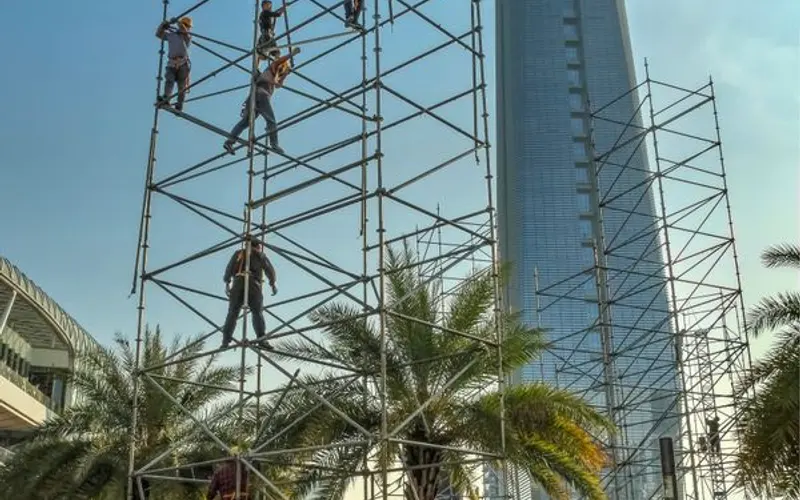
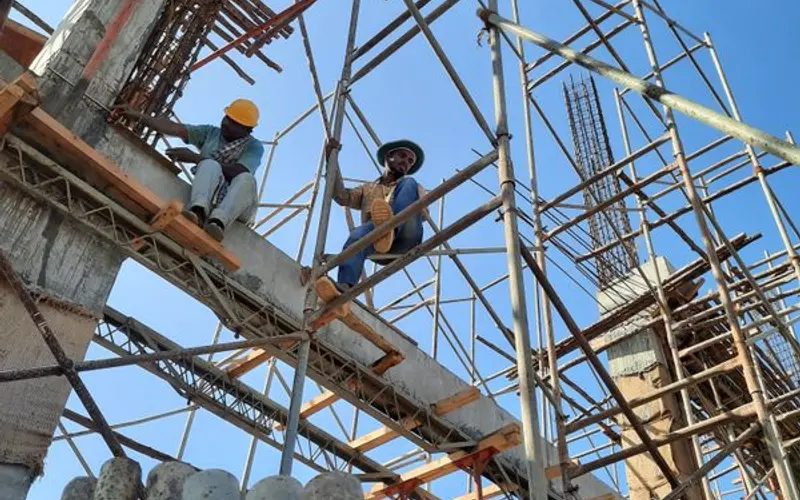
Scaffolding is a temporary structure of planks and poles that supports people who need to work at height: construction workers, inspectors, cleaners and others. It is also called staging, and it gives workers a stable platform.
People have used scaffolding since ancient times, in places such as ancient China and Egypt, where basic scaffolds were built from wood and tied with rope. Today's scaffolding is more advanced and comes in many designs and materials.
Types of scaffolding
- Single scaffolding: mainly for brickwork and simple masonry, with a single row of standards parallel to the wall, joined by ledgers.
- Double scaffolding: used for stone masonry, where it is hard to fix into the wall. It is a two-row structure that stands on its own.
- Cantilever scaffolding: used when the ground cannot support the standards. The standards are supported by needles projecting from holes in the wall.
- Suspended scaffolding: a platform hung from the roof by chains and ropes, common for painting and window cleaning on tall buildings.
- Trestle scaffolding: used for indoor work such as repairs and painting, on platforms supported by movable ladders.
Where scaffolding is used
- Construction: a stable, safe surface for work at height, especially on tall buildings.
- Industrial inspection: it lets inspectors reach areas for testing and visual inspection, for example inside large industrial boilers and on the outside of structures.
- Repairs and maintenance: inspectors find the areas that need work, and maintenance crews then reach them from the scaffold.
- Cleaning: workers stand on scaffolding to clean windows and other parts of tall buildings.
- Other uses: art displays, exhibition booths, grandstand seating, lookout towers and concert stages.
Benefits of scaffolding
- Balance: workers can keep their balance at different heights.
- Access: stable access to almost every part of a structure.
- Ease of construction: it is quick to set up and take apart.
- Long life: steel and wood scaffolds can last a long time.
- Safety: a secure, stable platform for people working at height.
- A bridge: scaffolding can shorten routes between work areas, so crews move faster.
The dangers of working on scaffolding
Working at height is dangerous, and a scaffold is a temporary structure. The most common dangers are:
- Falling objects: materials and tools can fall on workers below.
- Bad weather: rain and snow make planks slippery, and heat and cold can loosen parts and crack wood.
- Faulty parts: bent screws and steel tubes that do not fit properly.
- Breaking safety rules: overloading the scaffold.
- Weak planks, posts and supports.
- A bad set-up: skipping braces and secure fixings.
- A lack of regular checks, which lets a scaffold become unsafe over time.
An alternative: inspection drones
Scaffolding brings risks such as falls from height, dropped tools and long set-up times. Alternatives include rope access, which suits targeted maintenance because it is quick and flexible.
For industrial checks such as non-destructive testing, drones are a possible alternative. They gather photos, video and data from a safe distance, with no height risk, and can carry tools such as radiation dosimeters.
- Safety: workers stay on the ground.
- Cost: building and removing scaffolds is expensive.
- Speed: data is collected faster than by hand.
- Less downtime: operations are interrupted for less time.
Scaffolding training at Career Dreams
Career Dreams Technical Training Institute teaches scaffold erection, dismantling, inspection, safety requirements and practical applications in its Scaffolding course, and the inspection of scaffolding systems, components, tagging and safe use in its Scaffolding Inspector course.
Written by Career Dreams Technical Training Institute.