Introduction
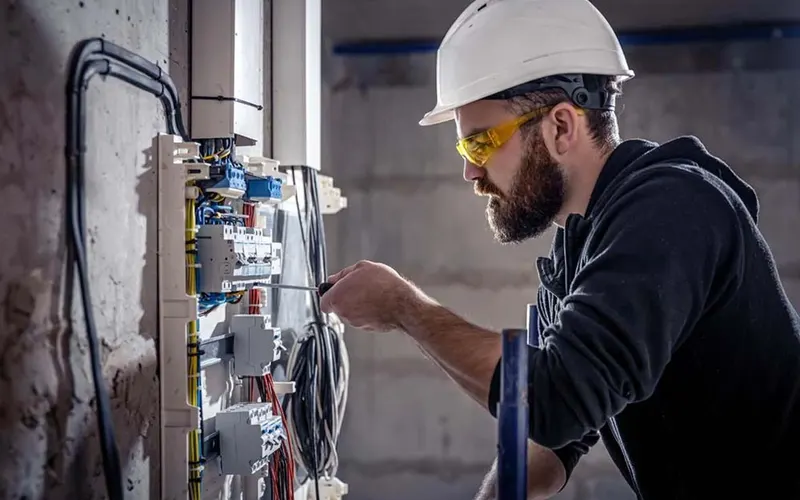
An electrician is a skilled person who installs, repairs and maintains electrical wiring and equipment in homes, buildings, factories and industrial and commercial sites. Electricians keep everything safe, fix faults, and look after parts such as lighting, circuit breakers and panels.
Essential electrician skills
- Following all electrical safety procedures.
- Repairing equipment, fixtures and wiring.
- Diagnosing faults.
- Using power tools effectively and safely.
- Installing cables, conduit and switches.
- Reading blueprints.
Key responsibilities and services
- Installation: fitting new electrical parts such as lights and circuit breakers so that homes, factories and offices are powered safely.
- Repair and maintenance: regular checks, repairing damaged wires, transformers and motors, and replacing worn parts.
- Troubleshooting: finding faults and testing circuits with tools such as a multimeter, then fixing the problem.
- Safety compliance: making sure the work follows safety rules, such as OSHA standards and the National Electrical Code (NEC), to prevent shocks, injuries and fires.
- Planning: reading blueprints and diagrams to plan where wiring and systems should go.
Common electrical services
- Replacing old panels and breakers with newer, more efficient ones.
- Installing lights, ceiling fans and smart systems to save energy.
- Repairing motors, control circuits and machinery.
- Running new wiring in walls and ceilings for new rooms.
- Testing electrical equipment for safety and function.
Types of electrician
- Residential: wiring, lighting and installation for homes, buildings and apartments.
- Commercial: work in hospitals, offices and shops, including lighting and fire protection, and designing the electrical framework of new buildings.
- Industrial: large electrical projects in factories, mines and power stations, mostly machinery and production systems.
- Maintenance: troubleshooting and repair to keep the electrical systems of facilities such as hospitals and hotels running safely.
- Construction: installing electrical systems in new buildings and renovations.
- Outside lineman: power distribution, outdoor lighting and high-voltage work, mainly for utility companies.
- Inside wireman: electrical installation in industrial and commercial construction.
How to become an electrician
Requirements and licensing differ from country to country. In general the path looks like this:
- Finish school, with a focus on physics and maths.
- Learn the basics of electrical work at a technical college or training institute.
- Join an apprenticeship or trainee programme.
- Build supervised on-the-job experience alongside classroom study.
- Pass the licensing exam on safety and theory where one applies.
- Gain experience as a qualified electrician, then move on to more advanced roles.
Core subjects to study
- Circuits, voltage, basic algebra and reading blueprints.
- Wiring standards, compliance, rules and regulations (such as the NEC).
- Safety standards: protective equipment, CPR, ladder safety and hazard prevention.
- A diploma in electrical work covering industrial and domestic wiring and repair.
- Apprenticeships: paid on-the-job training with classroom study.
Start at Career Dreams
Electricians have an important role in modern life, with clear training paths and steady demand. Career Dreams Technical Training Institute teaches industrial electrical installation, wiring, maintenance, testing and troubleshooting in its Industrial Electrician course.
Written by Career Dreams Technical Training Institute.